
Buying in Morocco
Titre foncier or melkia: the detail that decides if a riad can be resold, financed and kept
A titre foncier registered with the ANCFCC is irrefutable proof, enforceable against everyone, and it is the only document a bank accepts to finance a purchase. A melkia offers none of those guarantees. In the medina, many old riads are still sold on the basis of a melkia, a deed drawn up by adouls under customary Islamic law. That is not illegal in itself, but it is a different status, with concrete risks a rushed buyer often never sees before signing.
- →Titre foncier: irrefutable proof, enforceable against everyone, the only document banks accept for a mortgage.
- →Melkia: a deed based on witness testimony, with no precise topographic boundaries and no charges or mortgages recorded on it, the most common trap in the medina.
- →Converting a melkia into a titre foncier is a process that can take several years, with no reliable shortcut.
- →A property under undivided inheritance stays blocked from sale until every heir has signed the partition before a notary, including those scattered abroad.
- →A notary is never allowed to hold your funds themselves: the money passes through the Caisse de Dépôt et de Gestion, a direct legal protection for the buyer.
Verified on
Titre foncier or melkia, what is the difference?
The titre foncier is the registration system held by the National Agency for Land Registry, Cadastre and Cartography, the ANCFCC. Once a property is recorded there, ownership becomes irrefutable proof: it is enforceable against anyone, including a seller who changes their mind or a third party claiming an earlier right. Any charges or mortgages on the property are recorded on the same title, so you can see them before buying.
The melkia, sometimes spelled moulkiya, is a deed drawn up by adouls under customary Islamic law. It rests on witness testimony rather than a certified survey, and it has no precise cadastral boundaries. No charge, no mortgage is recorded on it, because there is no central register that would track them.
The most concrete consequence for a buyer: every Moroccan bank requires a titre foncier before granting a mortgage. A property sold under a melkia cannot be financed by a standard bank loan, however solid the buyer file is.
What are the risks of a property still held under melkia?
The first risk lies in the property boundaries themselves. Without a certified survey, the exact surface, the boundaries with neighbours and sometimes even the existence of right-of-way easements can stay imprecise. In a dense medina, where riads share walls on several sides, that vagueness is not theoretical.
The second risk is the lack of protection against a later claim. A titre foncier closes the matter for good. A melkia, resting on witness testimony, in theory leaves the door open to a challenge that resurfaces after the sale. We rely here on secondary sources, agencies and specialist firms, not an official text we read directly, and that nuance is worth knowing.
The third risk is time. Converting a melkia into a titre foncier, that is, moving it from one regime to the other, is a process that can take several years. There is no reliable shortcut and no guaranteed timeline, and a buyer planning a quick resale or a mortgage needs to factor that delay into the decision, not discover it after signing.
One special case deserves a cautious mention: habous, a mortmain property tied to a religious endowment. The sources we found on this topic are real estate blogs, not legal texts, so we treat this as generally reported rather than an established legal fact. What comes up consistently: a habous property is generally transferred through a long-term lease, not full ownership, which changes what the buyer actually acquires.
Why does undivided inheritance block so many medina sales?
Many old riads changed status through inheritance rather than sales. When the owner dies, the property is split among all the heirs under the applicable succession rules, and those heirs are sometimes numerous, sometimes settled far from Marrakech, including abroad.
Until the partition has been formalised before a notary and every co-heir has signed, the property stays legally blocked from sale. One missing heir, one refusal, and the deal cannot go through, whatever agreement is reached with the others. It is the most common obstacle buyers of medina riads run into, more common than the melkia status itself.
Before any serious negotiation, ask explicitly whether the property is under undivided inheritance, how many heirs are involved, and whether the partition deed has already been signed by all of them. A seller who dodges this question, or claims to represent the others without paperwork to back it up, is a signal worth taking seriously.
What do you check before signing, and what protects your money?
The ANCFCC lets you order a certificate of ownership, which shows the current owners, the description of the property and any charges or mortgages recorded. It also offers an online service, Mohafadati, to track the progress of paperwork on a title. The official schedule sets 100 MAD per certificate issued. It is the cheapest check in your whole purchase, and the one never to skip.
The issuing time, on the other hand, is not in the schedule and we have no source to state it. Ask at the counter or through your notary, and leave room for it in your signing timetable.
A convention signed in 2025 between the ANCFCC and the notaries order introduced Tawtik, a notarial platform interconnected with the land registry, rolling out the electronic notarial deed. We hold this from business press, not an official text read directly, and it describes a rollout in progress rather than a system already generalised everywhere.
On protecting your money, one point is solid: law 32-09 bans a notary from holding funds that pass through them on behalf of the parties. The money is deposited with the Caisse de Dépôt et de Gestion, an institution separate from the notary own assets. That is direct legal protection: be wary of any intermediary who offers to receive the money directly into their own account, that is not what the law provides for.
What we could not verify
Notary fee schedule : A sliding scale circulates on many sites, always attributed to the same decree, but we could not read that official text. So we do not put a number on it. Ask your notary for a written quote before signing.
Titre foncier, melkia, habous at a glance
This table simplifies a fine legal reality. It does not replace a notary or a lawyer reading the actual file.
| Status | What it guarantees | Level of proof |
|---|---|---|
| Titre foncier (ANCFCC) | Irrefutable proof, enforceable against everyone, accepted by every bank for a mortgage | Established legal fact |
| Melkia (moulkiya) | Deed based on witness testimony, no precise boundaries, no charges recorded | Converging secondary sources |
| Habous | Generally transferred through a long-term lease, not full ownership | Weak sources, confirm case by case |
| Undivided inheritance | Sale blocked until the partition is signed by every heir | Established succession-law mechanism |
| Funds held by the notary | Never held by the notary themselves, deposited with the Caisse de Dépôt et de Gestion | Law 32-09 |
The same word, riad, can hide a clean titre foncier or a melkia under undivided inheritance. Always check the real status before negotiating price.
Before signing on a medina property
- 1
Ask for the exact nature of the deed
Titre foncier, melkia or habous lease: the seller or their notary should be able to state it clearly, without ambiguity, from the first conversation.
- 2
Order an ANCFCC certificate of ownership
It shows the current owners, the description of the property and any charges or mortgages recorded, when the property already carries a titre foncier.
- 3
Check for undivided inheritance and heirs
Ask explicitly whether the property is under undivided inheritance, how many heirs are involved, and whether the partition deed has been signed by all of them before a notary.
- 4
Plan for the delay if the melkia is not yet registered
Converting a melkia into a titre foncier can take several years. Factor that delay into your decision before committing.
- 5
Check the funds pass through the Caisse de Dépôt et de Gestion
No intermediary, agency or individual should ever ask you to pay them directly.
Our houses in Marrakech

Évasion Chic, Appartement au Cœur de la Ville
📍 Hivernage, Marrakech 40000
Chic, comfortable one-bedroom in a central pool residence, ideal for couples, city breaks and business stays

Vue d'Exception & Jacuzzi, Majorelle
📍 Quartier Majorelle, Gueliz, Marrakech 40000
Top-floor 130m² apartment with private terrace jacuzzi and uninterrupted views over the Majorelle gardens
 ⭐ Top pick
 Maison Habibi, Dar el Bacha
📍 156 Arset Aouzal, Medina, Marrakech 40000
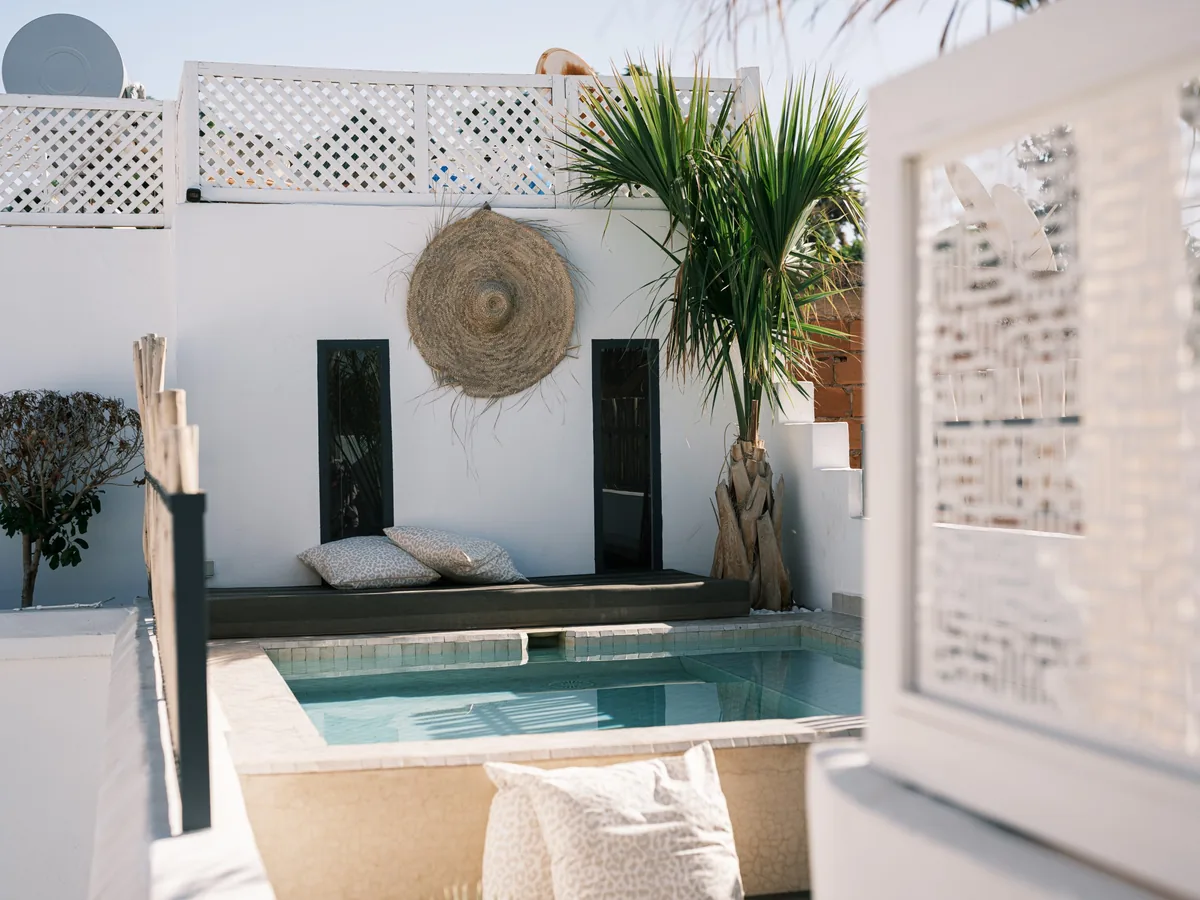
Whole-riad rental in Dar el Bacha, 4 double bedrooms, sleeps 9, heated rooftop plunge pool and summer kitchen, 12 min walk to Jemaa el-Fna. €313/night direct vs €330 on Airbnb, rated 4.97/5.
Frequently asked questions
What is the difference between titre foncier and melkia? +
A titre foncier is a registration held by the ANCFCC, irrefutable proof enforceable against everyone, with charges and mortgages recorded on it. A melkia is a deed based on witness testimony, with no precise topographic boundaries and no register of charges. Only the titre foncier is accepted by banks for a mortgage.
Can you get a bank mortgage for a property sold under melkia? +
No, not through a standard bank loan. Moroccan banks require a titre foncier to grant a mortgage. A property still held under melkia must either be paid for another way, or first converted into a titre foncier, a process that can take several years.
How long does it take to convert a melkia into a titre foncier? +
We cannot give a precise timeline, having found no official text on this point. Secondary sources agree the process can take several years, with no reliable shortcut or guaranteed schedule.
What is a habous property, and can it be bought like an ordinary one? +
A habous property is a mortmain property tied to a religious endowment. Available sources are real estate blogs rather than legal texts, but they consistently report that such a property is generally transferred through a long-term lease, not full ownership. That changes what the buyer actually acquires, and deserves specific verification before any offer.
How do you check the status of a riad before signing? +
The ANCFCC lets you order a certificate of ownership, listing the current owners, the description of the property and any charges or mortgages recorded, and offers the Mohafadati service to track paperwork on a title. The official schedule sets 100 MAD per certificate. The issuing time is not in it, so ask on the spot.
What happens if the property is under undivided inheritance between several heirs? +
The sale stays blocked until the partition has been formalised before a notary and every co-heir, including those living abroad, has signed. It is the most common block on medina riads, more common than the melkia status alone, and it must be checked before any price negotiation.
Sources and verification date
- Art. 133 du CGI, repris par Deloitte Avocats et Medias24 (4 %, converging independent sources, verified on 2026-07-25)
- Art. 133 du CGI (5 %, converging independent sources, verified on 2026-07-25)
- Décret n° 2-16-375, tarif des droits de la conservation foncière (ANCFCC) (100 MAD, official text read directly, verified on 2026-07-25)
Planning a purchase in Marrakech?
We manage riads and apartments directly in Marrakech, we are not an estate agency. If you want to understand a neighbourhood before buying into it, or stay there while you make up your mind, write to us.
Message us on WhatsApp